EcoTerra: Novato Yard Base Rock 1/2 price @ $5/ton
View Deal


.png)

Explore
.svg)
Who We Serve
.svg)
Media Hub
.png)
Other Links
.svg)
Part 3 of 10 — The Heavy Civil Supplier's Guide to Getting Found
By Ryan Brown, Chief Customer Officer, Bulk Exchange
There is a particular kind of website I have seen hundreds of times over the course of my career. You probably know the one. A homepage with a hero image that takes ten seconds to load. A navigation bar with About, Services, and Contact. A paragraph about the company's commitment to quality and its decades of experience. A phone number that may or may not still be answered. No product specs. No service area. No indication of what you actually supply, in what quantities, or to what kinds of projects.
The company behind that website is real. They know their business. Their customers like them. But the website doesn't reflect any of that. It was built once, probably by someone's nephew or a local agency that did it cheaply, and it hasn't been touched since.
I am not saying this to be harsh. I am saying it because I have watched good businesses lose real opportunities because their website couldn't do the one job it needed to do: convince a contractor who had never heard of them that they were worth calling.
That's the job. Not winning design awards. Not telling your origin story. Not impressing your existing customers, who already know you. The job is converting a stranger who found you through a search into someone who picks up the phone.
Most supplier websites completely fail at this. And most of the time, nobody inside the business knows it's happening.
In the last post in this series, we talked about Google Business Profile — the map pack listing that appears when a contractor searches for aggregate near a job site. When your GBP is set up well, contractors find you. That's the first win.
But here's what happens next. A project manager sees your listing in the map pack. Your name, your rating, your category. They want to know more before they call. So they click through to your website.
What they find in the next fifteen seconds determines whether they call you or close the tab and call someone else.
That's the moment your website either earns the lead or loses it. And most supplier websites lose it, not because the business is bad, but because the website was never built to do this job.
When a contractor lands on your website cold, they are not browsing. They are evaluating. They need to answer four questions fast, or they move on.
One: Do you supply what I need?
This sounds obvious, but most supplier websites bury their products under vague language. "Construction materials." "Aggregate solutions." "Quality bulk supply." A contractor sourcing base course material for a DOT highway project needs to see crusher run, #57 stone, highway base course, recycled concrete aggregate — the words they use, the specs they care about — within seconds of landing. If they have to dig for it, they're gone.
Two: Can you serve my project location?
Geography matters enormously in this industry. A quarry that is forty miles away may be perfect. One that is two hundred miles away is useless for most projects. Your website needs to state your service area clearly, not just your address, but the region you actually deliver to, the counties or corridors you operate in. If a contractor can't figure out whether you can reach their job site, they will assume you can't and move on.
Three: Can you handle my volume?
A highway widening project might need 80,000 tons over sixteen weeks. A commercial site prep might require 5,000 tons to be delivered over three days. These are very different jobs. If your website gives no indication of your production capacity, delivery capability, or minimum order requirements, a contractor planning a large project has no way to assess whether you're even worth the conversation. Silence on this question reads as "probably not."
Four: Are you legitimate?
This is the trust question, and it matters more than most suppliers realize. A contractor sourcing from a supplier they've never used before is taking a risk. A missed delivery or a gradation problem on a DOT job can cost them a penalty or a relationship with a prime contractor. They need to see evidence that you are real, experienced, and reliable. Reviews help. Project photos help. DOT approvals and certifications listed prominently help. A website that looks like it was abandoned in 2014 does the opposite.
Answer all four of those questions clearly and fast, and your website is doing its job. Leave any of them unanswered, and you are leaking leads you will never know you had.
Most supplier websites have too many pages on the wrong things and not enough on the right ones. Here is what actually matters.
A products page that reads like a spec sheet, not a brochure.
List every material you supply. For each one, include the common name, the gradation or spec, the typical application, and your available sizes or formats. Write it the way a contractor thinks about it, not the way a marketer would describe it. "3/4" clean crushed limestone, AASHTO #57, suitable for drainage, base course, and pipe bedding, is useful. "Premium quality aggregate products for all your construction needs" is not.
A service area page or a clear service area statement.
Either build a dedicated page or put it prominently on your homepage. Name the geography you serve. List the counties, metros, or project corridors. If you have delivered to projects on a specific highway or in a specific region, say so. Local specificity helps both your human readers and your search rankings.
A delivery and logistics page or section.
Contractors need to know how you operate. Do you own your fleet or broker it? What are your lead times? What's your minimum order? Can you sequence deliveries across a multi-phase project? Do you have a certified scale on site? These are the questions a project manager asks before they commit to a supplier relationship. Put the answers on your website so they don't have to ask.
Real photos.
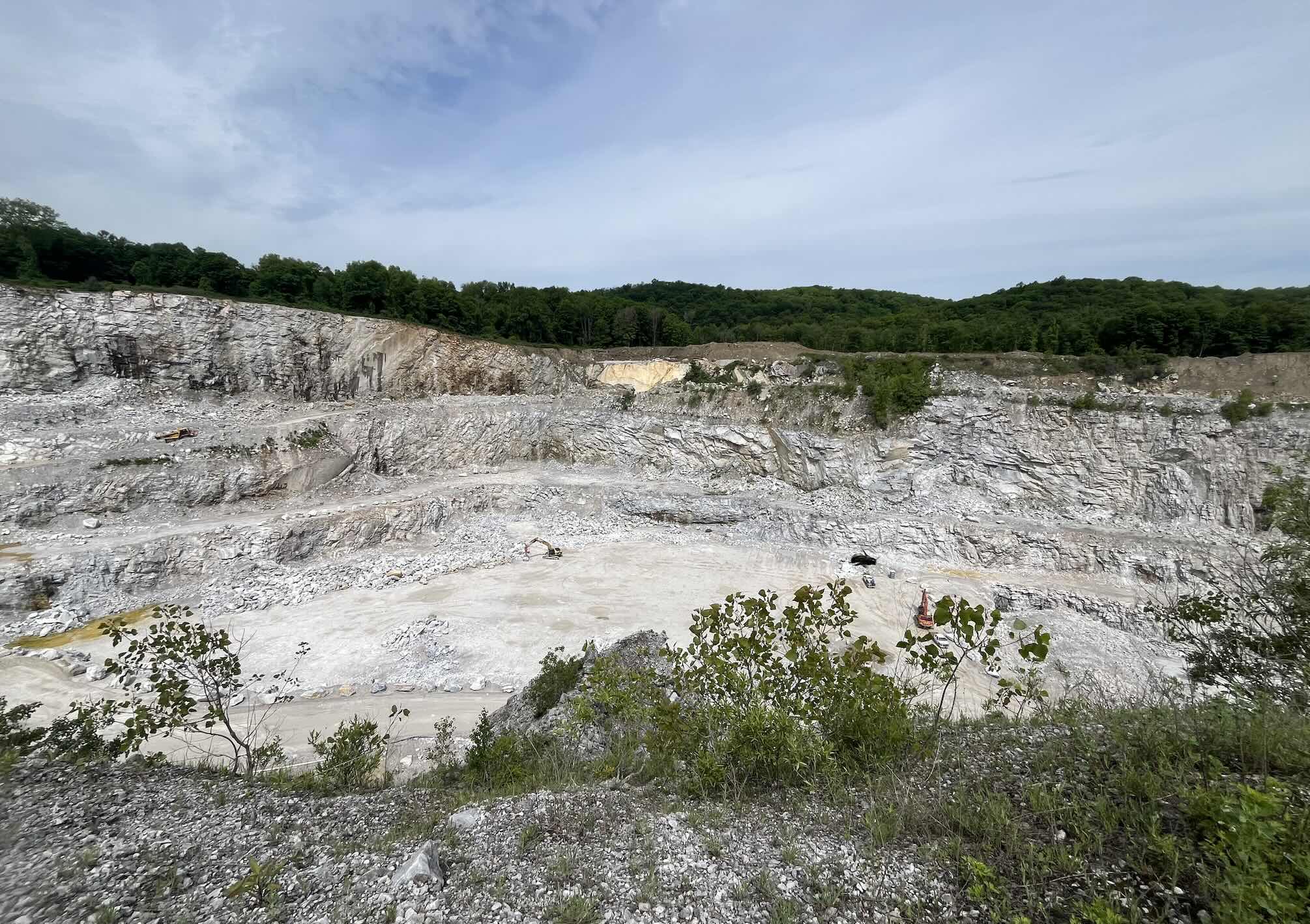
Not stock photography. Not a generic image of a dump truck that could belong to anyone. Photos of your facility, your stockpiles, your equipment, your deliveries. If a contractor is evaluating you against two other suppliers and your website shows real operations while the others show stock photos, you win the credibility comparison without even trying.
If you want to go a step further, consider using a service like Stockpile Reports to generate professional volumetric reports from aerial imagery of your stockpiles. The output gives you credible, data-backed documentation of your inventory that you can reference in your profile, on your website, and in contractor conversations. It also signals operational sophistication to buyers who are evaluating you cold.
A clear, frictionless contact page.
A phone number that is answered during business hours. An email address that reaches someone who responds within a day. If you have a dispatch or sales contact specifically for project inquiries, name them. Make it easy to initiate a conversation. Every extra click or form field between a contractor and a real person is a reason to give up and call someone else.
A website that converts leads well but can't be found is only solving half the problem. For your site to show up when contractors search for what you supply, it needs to speak Google's language, which mostly just means being specific, accurate, and well-organized.
A few things that move the needle most for supplier websites:
Location in page titles and headings. "Crushed Stone Supplier — Central Ohio" ranks better than "Our Products." Put your geography in your page titles, your H1 headings, and your meta descriptions. Be specific.
Dedicated pages for each major product type. A single "Products" page that lists everything you sell is less searchable than individual pages for each material. A page specifically about recycled concrete aggregate, with its own URL, title, and content, has a far better chance of ranking when a contractor searches for that material in your region.
Content that demonstrates expertise. A short article explaining the difference between crusher run and processed gravel for base course, or a guide to DOT gradation specs for highway subbase, does two things at once. It ranks for the questions contractors are actually searching, and it signals to every reader that your business knows what it's doing. That's E-E-A-T — Experience, Expertise, Authority, Trust — and it's what both Google and AI search engines are looking for when deciding who to surface.
Fast load times and mobile readability. A contractor on a job site is often searching on a phone with a variable cell signal. If your site takes more than three seconds to load, a significant portion of visitors never see it. Compress your images, keep your code clean, and test your site on mobile regularly.
We introduced Generative Engine Optimization in the first post in this series. Your website is one of the most important GEO assets you have.
When a contractor asks ChatGPT or Perplexity to recommend aggregate suppliers for a highway project in your region, those tools are crawling the web for credible, substantive content to cite. A website with clear product pages, geographic specificity, expert content, and cited sources is exactly what gets pulled into those answers. A thin, vague website with no real information gets ignored.
The bar for heavy civil supplier websites is genuinely low right now. Most of your competitors have sites that were built to exist, not to work. A website that clearly answers the four contractor questions, loads fast, and contains a few pieces of genuinely useful technical content will outperform 80 percent of the competition in your region, on Google and in AI search, without any paid advertising.
If your website is the "commitment to quality" variety and a full redesign feels like a six-month project you don't have the bandwidth for, here is what I'd actually do first.
Add a service area statement to your homepage today. One paragraph. The region you serve, the project types you support, the materials you supply. Plain language. That single addition will make your site more useful to more contractors than most other changes you could make.
Then build your products page properly. One section per material, with real spec language. This alone will start generating organic search traffic you are not getting right now.
While you are working on the website, get listed on Bulk Exchange. A complete Bulk Exchange listing puts you in front of contractors who are actively searching for suppliers like you, today, not six months from now when your website redesign is done. The two are not in competition. A strong website and a complete Bulk Exchange listing are the two most powerful things you can do to make your business findable to the next generation of heavy civil contractors sourcing materials for the projects being built right now.
Your website is where contractors evaluate you. But there is another layer of visibility that most heavy civil suppliers have never thought about at all: the content they produce, or more accurately, the content they don't. Next week, we'll look at why a single well-written article about something contractors actually search for, gradation specs, material selection, DOT compliance, project logistics, can generate more qualified inbound interest than any ad you've ever run.
Ryan Brown is Chief Customer Officer at Bulk Exchange, the construction industry's trusted platform for sourcing and discovering bulk materials in heavy civil construction. Bulk Exchange connects contractors with aggregate suppliers, ready-mix producers, fill material providers, disposal sites, and other bulk material sources across Canada and the United States. Learn more at bulkexchange.com.
Series: The Heavy Civil Supplier's Guide to Getting Found
Part 1: Why Heavy Civil Material Suppliers Are Invisible Online — And Why That's About to Change
Part 2: Why Your Google Business Profile Might Be Your Most Valuable Free Marketing Tool
Part 3: Does Your Quarry or Plant Website Actually Help Contractors Find You?
Part 4: Why One Article About Aggregate Specs Can Outperform Every Ad You've Ever Run (Coming next week)
Related topics: aggregate supplier website, quarry website SEO, construction material supplier website, heavy civil supplier online presence, bulk material supplier website optimization, contractor supplier credibility, aggregate supplier near me, ready-mix concrete supplier website, DOT aggregate specifications, heavy civil marketing series


