EcoTerra: Novato Yard Base Rock 1/2 price @ $5/ton
View Deal


.png)

Explore
.svg)
Who We Serve
.svg)
Media Hub
.png)
Other Links
.svg)
Part 7 of 10 | The Heavy Civil Supplier's Guide to Getting Found
By Ryan Brown, Chief Customer Officer, Bulk Exchange
Ask a material supplier how many Google reviews their business has, and you will usually get one of two answers. A long pause, followed by “I honestly have no idea.” Or an exact number, followed immediately by an explanation for why it is so low.
I have spent 25 years working with business owners across nearly every industry you can name, and one pattern holds no matter what they sell. The businesses doing the best work rarely ask their customers to say so in public. They assume good work speaks for itself. It does not speak for itself online, and it certainly does not speak for itself to a contractor who has never worked with you before and is trying to decide whether to trust you with a project worth real money.
Heavy civil material suppliers are some of the worst offenders. Look up the reviews on almost any quarry, ready-mix plant, or fill material provider serving a metro area, and you will usually find one of two things. Nothing at all, or a handful of years-old reviews left by someone unrelated to the actual business relationship.
Contractor reviews for material suppliers are one of the most overlooked marketing assets in this industry, and fixing it costs nothing but a little consistency.
Restaurants ask for reviews because a bad one shows up on Yelp within the hour, sitting right where the next customer deciding where to eat can see it. Dentists ask because a five-star rating next to a new patient's search results is the difference between a phone call and a scroll past. Heavy civil never developed that instinct, and it is easy to see why.
Your customer relationships run for years, not one visit. The person who decides whether to keep buying from you is rarely the person standing at the scale house when the truck rolls through. Asking a project manager to leave a public review after a load of crushed stone can feel strange in an industry built on handshakes and repeat orders, not star ratings. And in most supplier operations, nobody actually owns marketing, so nobody ever thinks to ask.
None of that changes what a new contractor sees when they search for you. They do not see your history. They see whatever is sitting on your profile right now, and for most suppliers, that is close to nothing.
A review is not just a nice comment sitting on a profile. It does three specific things for your business.
According to BrightLocal's Local Consumer Review Survey, 75 percent of consumers say they always or regularly read online reviews when researching a business. A contractor sourcing aggregate for a new project is doing exactly this. They are checking whether other people like them had a good experience before they pick up the phone.
We covered your Google Business Profile in Part 2 of this series, and reviews are one of the biggest levers inside that profile. Whitespark's 2026 Local Search Ranking Factors survey, which asks a panel of local SEO experts to score how much weight each signal carries, found that review signals grew from 16 percent to 20 percent of local pack ranking factors since the last edition of the study, making reviews one of the fastest growing pieces of how Google decides which three businesses show up on the map when a contractor searches for a supplier near a job site.
We introduced Generative Engine Optimization, or GEO, in Part 1. Reviews feed directly into it. The specific language contractors use when they leave a review, such as: delivery arrived on schedule, gradation matched the spec, weight tickets were accurate, is exactly the kind of firsthand, credible detail that AI search tools pull from when a project manager asks an AI assistant to recommend an aggregate supplier or ready mix producer in their area. Generic marketing copy does not carry that same weight. A real review from a real customer does.
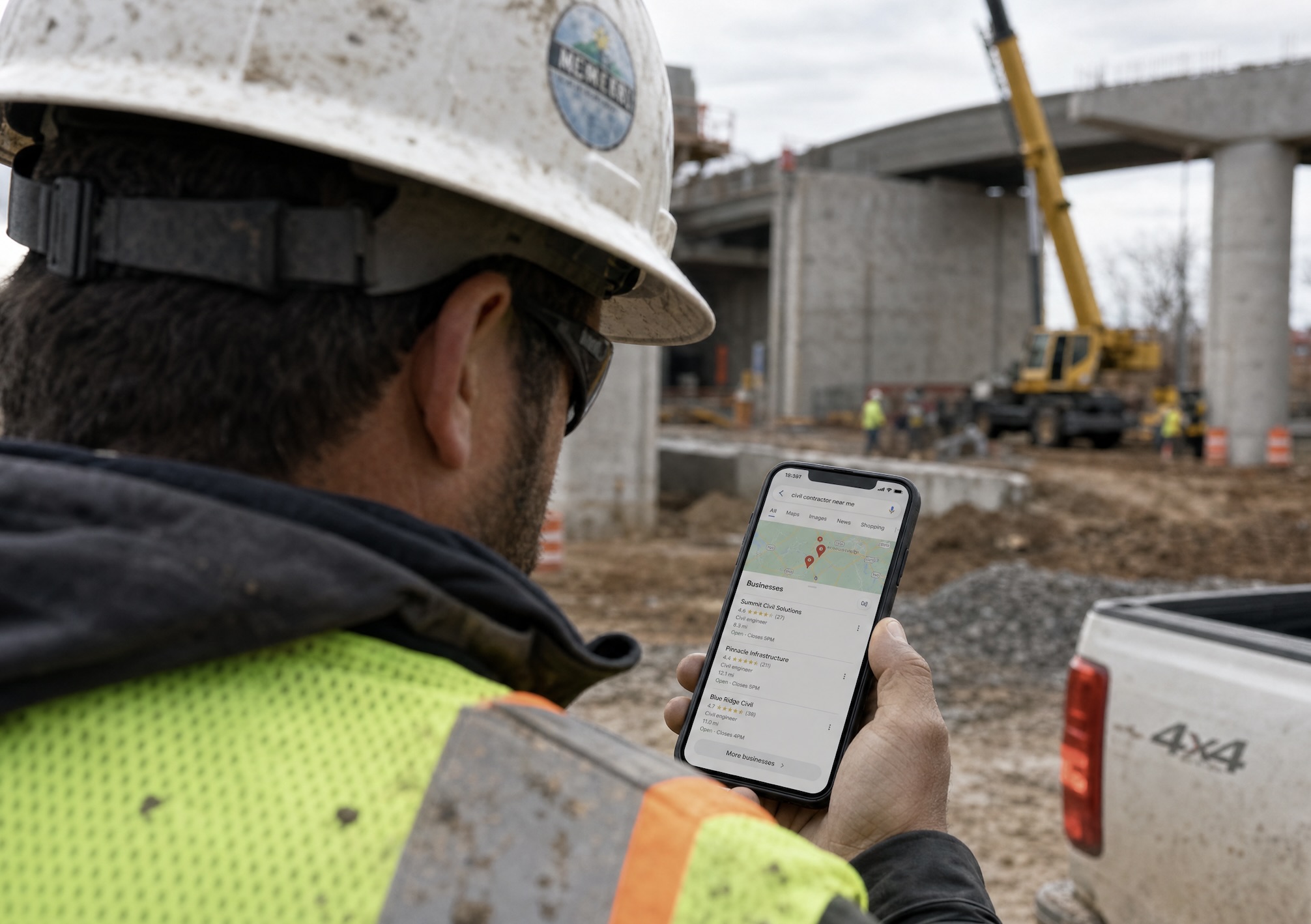
Picture a contractor comparing three suppliers in a Google map pack before making a call. One has 40 reviews averaging 4.6 stars. One has three reviews from years ago. One has none at all. The contractor is not thinking about which supplier has the best material. They cannot know that yet. They are thinking about which one is real, active, and worth the risk of a first order.
Zero reviews does not read as neutral to that contractor. It reads as unproven. A quiet supplier with a strong safety record and decades in business can look less credible online than a newer competitor who simply asked ten customers to leave a few honest sentences. Specific reviews also demonstrate the experience, expertise, authority, and trust that search engines and AI tools are increasingly built to reward. A review that mentions your delivery window, your gradation accuracy, or how your team handled a schedule change does more for your supplier credibility online than a generic five star rating ever will.
None of this requires new software or a marketing hire. It requires a short list of habits.
Responding to reviews, positive and negative, is itself a signal Google and AI search tools read as a sign your business is active and engaged. It also shows the next contractor who reads your profile that someone is paying attention.
For a positive review, a short, genuine reply is enough. Thank the customer by name if the platform allows it, and mention the project or material if you can. For a negative review, respond professionally and specifically. Acknowledge what happened, state what you did or will do about it, and invite the conversation offline if it needs more detail than a public reply allows. A single negative review handled well rarely hurts you. An unanswered one sitting next to nothing else becomes the only story your profile tells.
There is no fixed number, but the gap between zero and even ten to twenty recent reviews is enormous. Volume signals an active, trustworthy operation. A steady trickle of new reviews over time matters more than a single push to collect fifty at once.
Rarely, if you respond to it well. What actually hurts you is a profile with almost nothing on it at all, where one old complaint becomes the entire narrative because there is nothing else around it to balance the picture.
Both. Google reviews drive your visibility in local search and the map pack. Reviews and a completed project history on a platform built for this industry, like Bulk Exchange, put your credibility directly in front of contractors who are already actively sourcing materials, not just browsing generally.
You do not need a review campaign. You need five things done this week.
Next week, we look at project case studies, and how turning your best completed jobs into content gives a contractor something even more convincing than a five star review. Proof that you have already done exactly what they need done.
Ryan Brown is Chief Customer Officer at Bulk Exchange, the construction industry's trusted platform for sourcing and discovering bulk materials in heavy civil construction. Bulk Exchange connects contractors with aggregate suppliers, ready mix producers, fill material providers, disposal sites, and other bulk material sources across the United States. Learn more at bulkexchange.com.
Series. The Heavy Civil Supplier's Guide to Getting Found
Part 1. Why Heavy Civil Material Suppliers Are Invisible Online (And Why That's About to Change)
Part 2. Why Your Google Business Profile Might Be Your Most Valuable Free Marketing Tool
Part 3. Does Your Quarry or Plant Website Actually Help Contractors Find You?
Part 6. Why LinkedIn Is the Most Underused Sales Tool for Heavy Civil Material Suppliers
Part 7. Why Contractor Reviews Are the Hidden Marketing Asset Heavy Civil Suppliers Ignore
Part 8. How Heavy Civil Material Suppliers Can Use Project Case Studies to Win New Business (Coming next week)
Related topics. contractor reviews for material suppliers, aggregate supplier reputation online, Google reviews construction materials, how to get reviews as a quarry, supplier credibility online, heavy civil supplier marketing series, The Heavy Civil Supplier's Guide to Getting Found


